
Introduction: The Real Problem Teachers Face Every Day
All the teachers have had such a frustrating experience. A student puts up his hand, gets his answer right, then gets stuck, when questioned: But why is that true? The next thing is silence, rambling in a vague manner, or even worse, an answer that does not indeed indicate how the thinking has led to the answer.
Educators desire their learners to exhibit higher levels of comprehension. They would like the students to support their ideas with evidence and justify their arguments. However, in the absence of a proper structure, students cannot formulate their ideas in a coherent and rational manner. It is not an unintelligence or diligence but a disorganization
This is where claim evidence reasoning (often called the CER format) becomes a game-changer. When teachers in America learn to teach students how to create powerful arguments, back them up with sound evidence, and have them tell us the rationale behind them linking, something becomes different. Students begin to think in a more critical manner. Their writing improves. Their knowledge is increased
CER is not a robot implementation. Numerous teachers give it a trial, achieve varying outcomes, and ask themselves whether the framework is functional. The truth? When correctly taught by teachers, it is brilliant–when not
This guide will take teachers through the specifics of what exactly CER is, why it is important, the idea of rolling it out in just 2 weeks, and how to prevent those pitfalls that undermine student achievement
Section 1: Why Your Students Are Having Problems with CER (And It is not their fault)

Knowing the actual Obstacle.
Enter any science classroom and tell a student to justify their response and they usually provide you with unrelated facts. They will say: Plants should be exposed to the sunlight. It is true, but it is only a claim hanging in the air with no evidence to prove that.
It is not the case that students are ill-equipped with ideas. The problem is that they are fighting since no one ever taught them how the actual structure should be used to structure their thinking into a complete answer. This is where the critical thinking fails, not due to the absence of knowledge, but due to the absence of scaffolding
What Students Actually Need
Educators all over the country have observed that when learners are taught to build a sound argument, collect certain data through observations or experiments, and describe the line of reasoning between the two, they can all at once make things sensible. They become more skilled problem solvers. They get to think like scientists, historians and writers
The question structure- Is it by asking why does ice float? or What caused this historical event?–it is easier to answer when the students are presented to the question in an organized manner. They do not give a rambling argument but break their response into three logical sections
Why CER is Important in a Modern Classroom
State standards require more profound knowledge. Testing is not about the identification of facts only but the explanation of concepts. By teaching students this inquiry-based method of developing explanations, teachers are not only assisting students with a single assignment, but also developing some basic skills in critical thinking, which will be applied to all subjects
Quick Win Teaser: At the conclusion of this paper, teachers will have an easily available two-week plan that does not involve any extra preparation
Part 2: The 3-Part CER Formula That Works (With Real Examples)

Decomposing Every Part.
The Claim is the first statement in which the answer to the question is given. It is not a background information, it is the central point that a student is arguing. A powerful assertion is an idea that is presented in a clear and assertive manner
Specific data, observations or facts that substantiate the claim are the evidence. This could be through personal experiment, science research, literature reading, or in classroom. The point is that the evidence must be described and directly related to the demonstration of the claim
The Reasoning is the part, in which students give their explanation why the evidence supports their statement. This is the cause-and-effect reasoning that differentiates profound knowledge and mere knowledge. Rationality bridges the gap between what students see and what they think
Comparison Weak vs. Strong, Side-by-Side
Weak CER Response: Ice floats on water due to density. Water is denser. Ice is less dense.”
Problem: Vague claim, minimal evidence, reasoning that just repeats the claim without explaining.
Good CER Response: The reason why ice floats on water is that ice is less dense than liquid water. As water freezes, its molecules become apart and form more space between them, which makes the water in it lighter than the water surrounding it. that is why ice cube remains on the surface-things that are less dense settle in the denser liquids, and, according to this principle of buoyancy, things that are lighter than others
What Changed: The statement is not general, the evidence is not general (molecular spacing), the argument really reflects the cause and effect association
Why Order Matters
The order, claim first, then evidence, then reasoning, is the way scientific explanations attempt to work. A scientist is proposing a hypothesis, he or she presents some data, he/she then explains how such data supports the hypothesis. Through this structure, students are able to think in an organized and logical manner.
Section 3: Your 2-Week CER Launch Plan (No Prep Required)
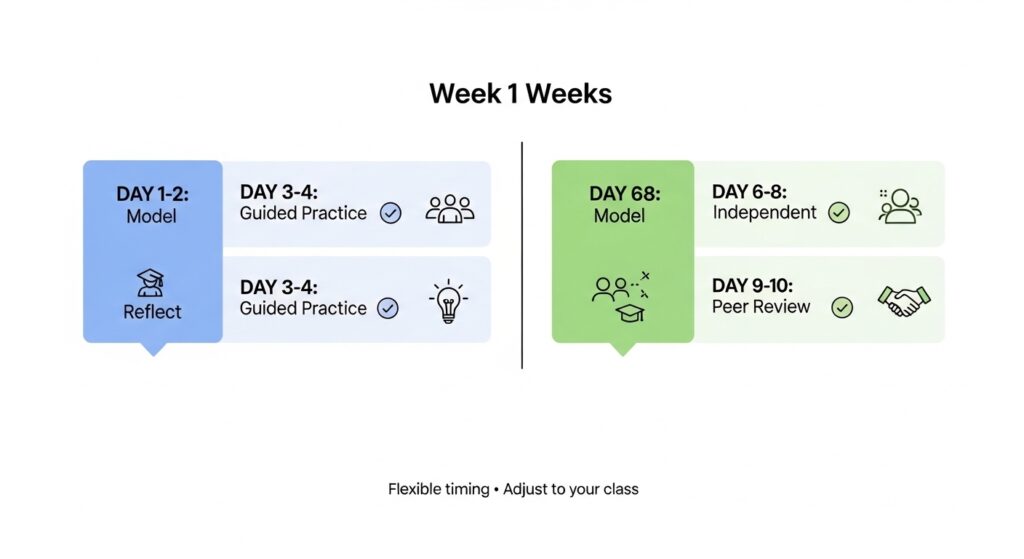
This framework can be adopted by teachers in a short period of time. The day by day strategy is as follows:
Week 1: Model, Practice, Reflect
Day 1-2: Teacher Models The teacher chooses a question of inquiry of interest to the current learning. For instance: What is the reason plants are more productive in the sun? The teacher then develops a complete CER response aloud and thinks out loud so that students can observe the actual process. This is a simulated approach to the way a good claim is vocalized, what good evidence is, and how the reasoning can clarify the relationship
Day 3-4: Guided Practice Students collaborate and work with teacher aid on a new question. The lesson develops the argument collectively, and collectively assembles the evidence based on a collective experiment or text, and then collectively writes the rationale. Sentence starters are applied such as I claim that… or “The evidence shows…” eliminates blank-page anxiety in students.
Day 5: Reflection Students are shown the examples that follow, and they are asked to discuss what made them effective. This review checklists strategy assists the students to internalize the structure.
Week 2: autonomy and Evaluation
Day 6-8: Independent Writing Students independently address a new question. The quality of the response of students must be varied. There will always be students who will not do well. Its aim is growth, not excellence
Day 9-10: Peer Review and Assessment Students Select a partner and review their work and evaluate it using a basic checklist: Does this statement respond to the question? Is the evidence specific? Does the rationale give a reason why? This peer review process is a process that enriches the knowledge of both the writer and the reviewer.
Ready-to-Use Warm-Up Examples
Example 1 (Science): “Why then does photosynthesis need sunlight? Students compose a three part response with support of evidence in their unit
Example 2 (Any Subject): What would it be like in case the sun stopped shining on the earth? Students make predictions, evidence searching, and they justify the cause-and-effect chain
Section 4: 7 CER Mistakes That Bone Student Writing (+Fixes)

Error number one: jumbling Evidence and Reasoning
What It Looks Like: “The evidence is that the plant became higher since it had more sunlight
The Fix: Separate them. Facts are the answer to what occurred. Rationalization is the answer to how it occurred.
Error #2: Generic statements which fail to answer the question.
What It Looks Like: “This involves photosynthesis. (Not a claim–it’s a topic!)
The Fix: of the claims should be full sentences and should respond to the question asked
Error number 3: Unrelated Data Dump.
What It Looks Like: Listing of long lists of facts and making no explanation of how these facts demonstrate the statement
The solution: Have students pick 2-3 pieces of evidence that they consider strong, and explain each one of them.
Error number four: Fallacy of Reason Reiterating the Statement.
What It Looks Like: Ice floats since it is floating.
The Repair: Model cause-and-effect language: This happens because…. or this is an illustration of my assertion as…
Fallacy: Failure to Find the Bridge Between Claim and Evidence.
What It Looks Like: The reader does not appear to have anything to do with evidence and claim.
The Solution: Transition phrases: This evidence supports my claim because, this shows that, or this means that.
Error number six: Lack of sufficient detail in Evidence
What It Looks Like: “We had an experiment and it was successful
The Interim Remedy: Go into details: in our experiment the plant placed in the sun grew 3 inches, and the plant placed in the shade grew only half an inch.
Error number 7: Lost Focus on the Audience.
What It Seems To Be: Writing in too technical or too casual way
The Fix: Remind the students that they are explaining to a person who does not know the answer but should know, be clear but not patronizing
Section 5: The Research + Real Results (Why CER Works)

Alignment With Standards
The NGSS (Next Generation Science Standards) focuses on the fact that students should develop evidence-based explanations. The requirement is directly fulfilled by CER format. When teachers teach with this framework they are not imposing any additional work they are teaching what standards require.
Real-World Results
One middle school put in place an organized CER instruction in science classes. In a semester, the scoring score in writing assessment on standardized tests had improved by 30%. More to the point, educators saw students pose more effective questions in discussions and think more about solving a problem
Why It Works
This method combines scaffold, repetition and feedback which research indicates constitute long-term learning. Students do not simply memorize a structure, they practice, watch examples, think about it, and perfect it.
Summary: Your Next Step
Teachers do not require complex materials and protracted preparation to impart CER. All they require are a definite framework, a modelling that is regular, and chances of guided practising. This two weeks plan will provide you with all that.
Begin this week. Choose a single question. Model a full CER response. Follow the organization of thoughts of your students. It is then that learning takes place
The framework works. All that students require is a teacher who points them on the right direction.
Frequently Asked Questions
How long does it take students to master CER? Most students show competence within 3-4 weeks of consistent practice, with continued improvement over the year.
Can CER work outside of science class? Absolutely—it transfers to history essays, literature analysis, and persuasive writing across all subjects.
What if my students still struggle after two weeks? Continue modeling and practice; some learners need more scaffolding, and that’s okay.
Should I use graphic organizers or let students write freely? Start with organizers to build structure, then gradually release toward independent writing.
How do I grade CER responses? Create a simple rubric with criteria for claim clarity, evidence quality, and reasoning strength.
Can advanced students skip the structure? No—even sophisticated writers benefit from this framework for clarity and organization.